Progress Report 3
We met with the following goals:
- Integrate all four sensors into one circuit
- Decide how to go about incorporating three sets of binary data and a highly nonsensitive vibration sensor
- Start understanding how to connect LEDs to simulate a traffic signal
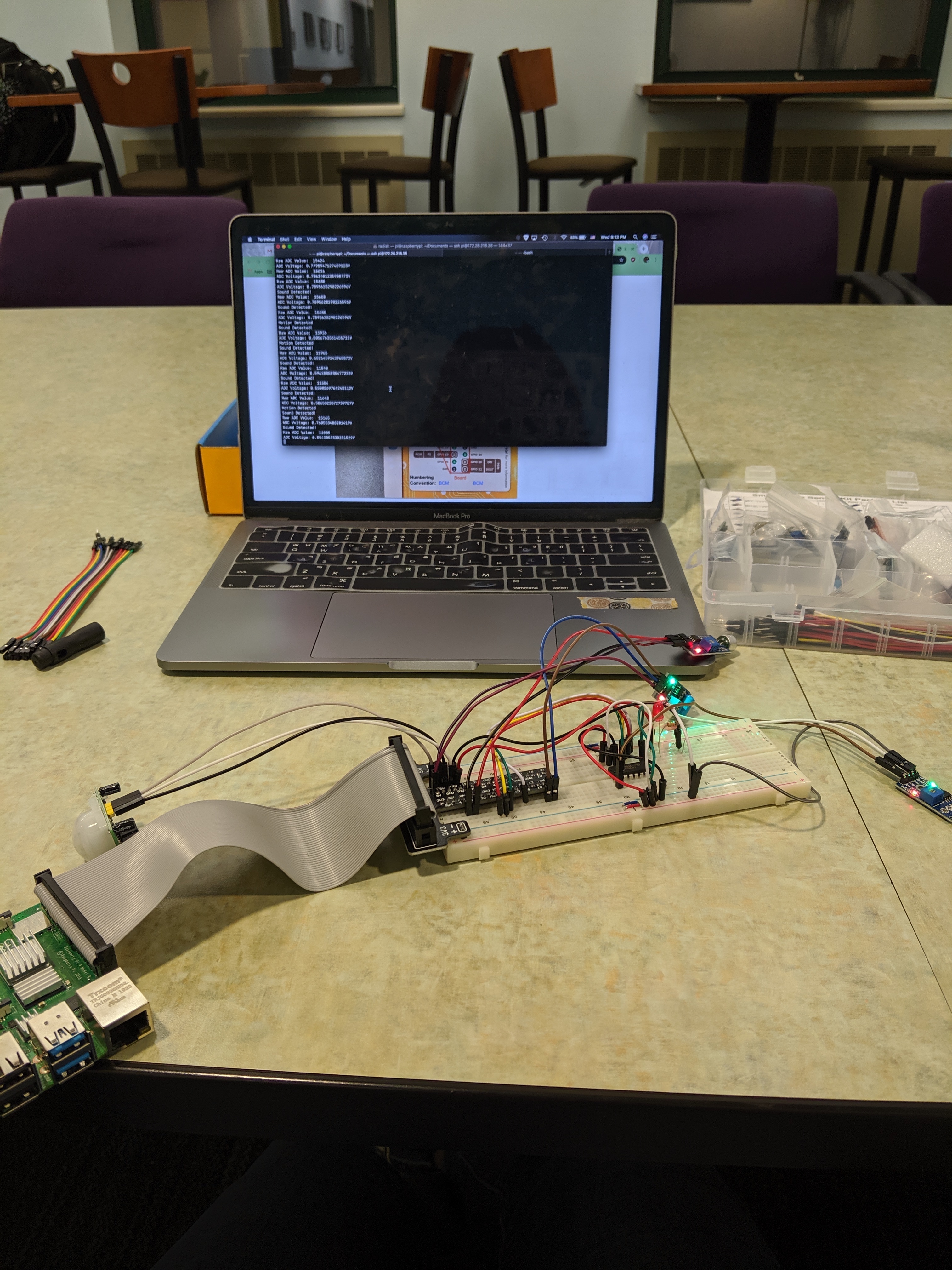
Since we had already connected the motion and photosensitive sensors together, it was easy to connect all four sensors in one python script. At this point we became very comfortable with the motion sensor. We were able to be in the same room and see quick changes between when motion is detected and when it is not detected exactly in line with how we were moving. In addition, we were able to adjust the sensitivity of the sound sensor so that it detected our speaking much more precisely.
The image below shows our circuit with all four sensors and the data being collected on the screen.
Regarding the vibration sensor, we decided to eliminate it altogether. We didn’t envision the vibration sensor to actually contribute any useful data to our system, unfortunately. Of course, this is specific to this vibration sensor in particular. If we were to implement this project with a higher budget we would definitely try to find a more sensitive and more accurate vibration sensor that collects continuous data. We believe that, in a more practical situation, this data would be extremely useful, and we regret that we are not able to implement that portion of our project plan. Instead, since we became such good friends with the motion sensor, we decided to add a motion sensor to our system with the goal of using one motion sensor to detect cars and the other to detect people. As such, we envision our system being inside of a box and both motion sensors being stuck to opposite sides of the box so that one side is facing the road and the other is facing the sidewalk. Since our motion sensors work so well, we believe that this will be effective in detecting cars and people for our purposes.
Finally, we started implementing our traffic signal simulator, but connecting the LEDs on top of all four sensors proved to be difficult. We encountered a wide variety of bugs and plan to go back tomorrow to better understand how to connect multiple LEDs to one circuit and have them turn on at different times. In the end we hope to have two sets of LEDs, one red and one green in each set. One set will be for the pedestrian signal and one will be for the traffic light.